
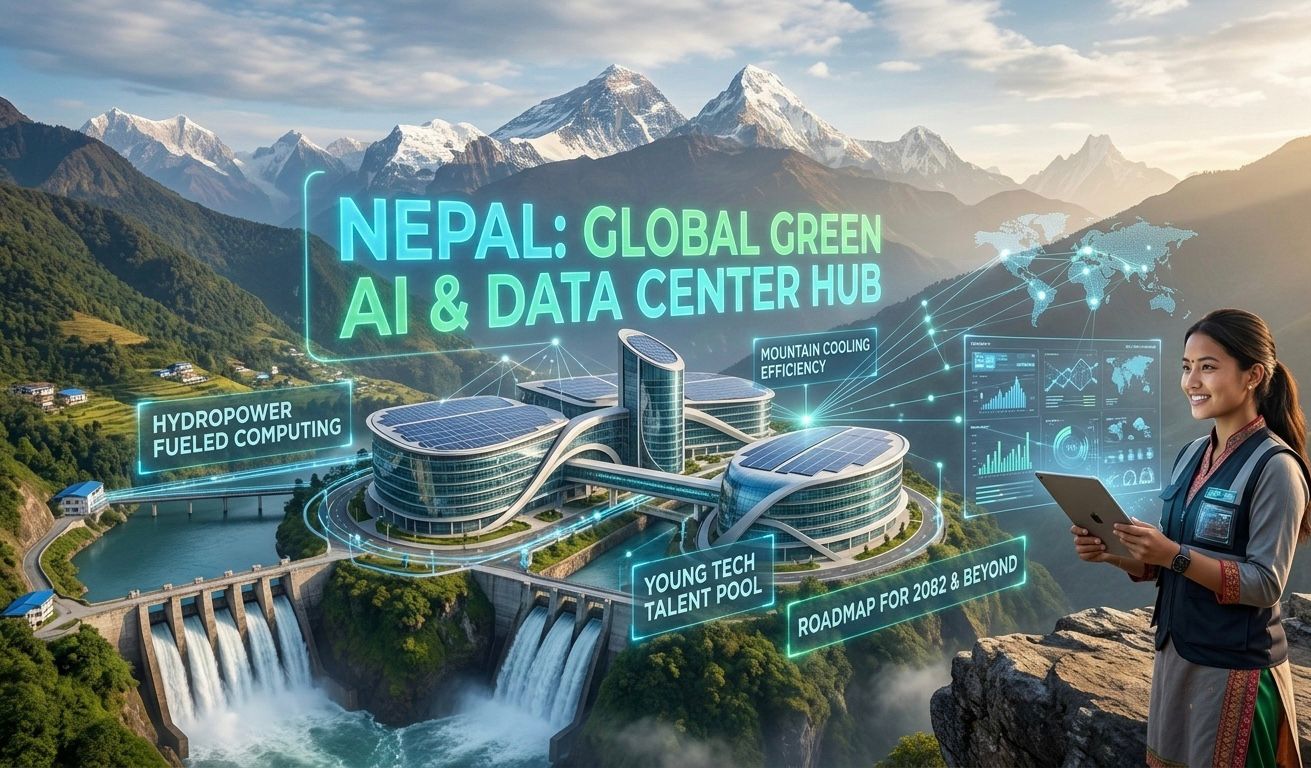
From Himalayas to High-Tech: Nepal's Geopolitical Opportunity in the Global AI Race
Artificial intelligence is transforming the global economy but it is also creating an unprecedented demand for electricity. Nepal, a country better known for its Himalayan peaks than its server farms, may hold an unexpected advantage in this new technological race. What was an abstract proposition twelve months ago is now a live policy contest and the clock is running.
In August 2025, the Government of Nepal officially approved the National AI Policy 2082 the country's first formal national framework for artificial intelligence governance. On November 10, 2025, Nepal inaugurated its National AI Centre in Kathmandu. And in December 2025, Nepal's Foreign Secretary stood before the country's senior diplomatic community and declared AI an explicit foreign policy priority, specifically naming Nepal's hydropower resources and naturally cool climate as assets for green data center development. These were not ceremonial words. They were a belated but real acknowledgment that the infrastructure race is already underway and that Nepal's entry into it is overdue.
The question this article poses is direct: now that the policy exists on paper and the institutional scaffolding is being assembled, does Nepal have the strategic architecture to act before the window closes?
To understand the opportunity, you need to understand the demand. According to the International Energy Agency (IEA), global data centers consumed approximately 415 terawatt-hours (TWh) of electricity in 2024 — roughly 1.5% of total global consumption — and this figure is projected to more than double to 945 TWh by 2030, growing at approximately 15% annually, more than four times faster than every other electricity sector combined.1 AI-focused workloads alone are growing at 30% per year, compared to 9% for conventional computing.
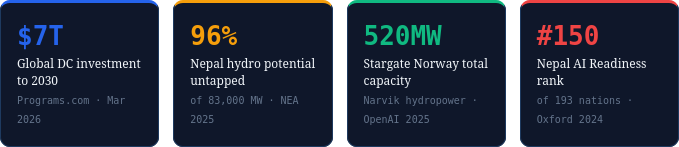
This is not a forecast. It is already happening. As of March 2026, companies worldwide are expected to invest nearly $7 trillion in building and upgrading data centers between now and 2030.2 The most dramatic evidence of this capital mobilization is Project Stargate the joint venture launched in January 2025 by OpenAI, SoftBank, and Oracle, backed by $500 billion in committed infrastructure investment, targeting 10 gigawatts of AI data center capacity across the United States and beyond. A single hyperscale AI data center draws as much electricity as an aluminum smelter. Cooling systems account for roughly 40% of that load. The average facility consumes 300,000 gallons of water per day.
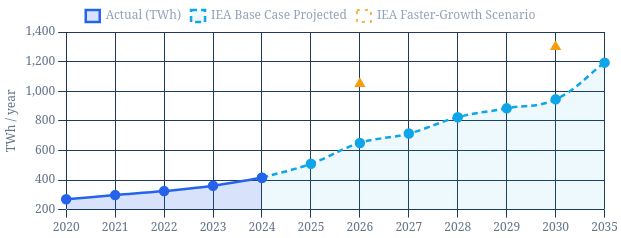
Source: IEA Energy and AI Special Report 2025¹ · S&P Global Nov 2025 · Carbon Brief Sep 2025 | Blue = Actual · Dashed = IEA Base Case · Triangle = Faster-Growth Scenario
2026 IEA range: 650–1,050 TWh confirmed · 2030 base case: 945 TWh · 2035 IEA projection: 1,193 TWh · AI share of DC load rising to 35–50% by 2030 · AI-enabled utility cyberattacks tripled in 4 years (IEA 2025)
"Nepal holds an estimated 83,000 megawatts of theoretical hydropower potential. It currently generates around 3,000 megawatts less than five percent of what its rivers could produce."
According to the International Renewable Energy Agency (IRENA), renewable energy investment globally surpassed $1.7 trillion in 2023, yet the bottleneck is no longer capital, it is location.Nepal exported 1.94 billion units of electricity worth Rs 17 billion in FY2023/24, the first year in its history it became a net electricity exporter. Seasonal exports to India reached 600 megawatts. Electricity trade with Bangladesh has begun through India's grid. These numbers are significant. But selling raw electricity across a border remains the lowest rung of the value ladder.
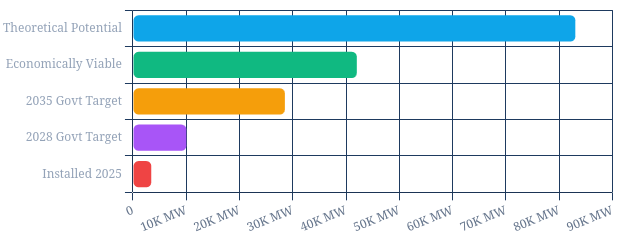
Source: Nepal Electricity Authority / SAARC Chamber, 2024 | Government of Nepal energy targets
Only 4.1% of theoretical potential is currently harnessed. National AI Policy 2082 explicitly guides the opening of data centers leveraging cold Himalayan temperatures.
Countries like Iceland, Norway, and Finland identified a more sophisticated play years ago attracting data centers that consume electricity locally and export digital services globally through fiber-optic cables. The Nordic data center market was valued at $7.16 billion in 2024 and is projected to reach $14.9 billion by 2030, growing at a CAGR of 12.8%.4Norway derives more than 95% of its electricity from hydropower and achieves Power Usage Effectiveness (PUE) ratios near 1.07 among the best in the world on the back of fjord-water cooling. Iceland's data center market, powered entirely by geothermal and hydro energy, was valued at $425 million in 2024 and accounts for over 5% of the country's GDP.
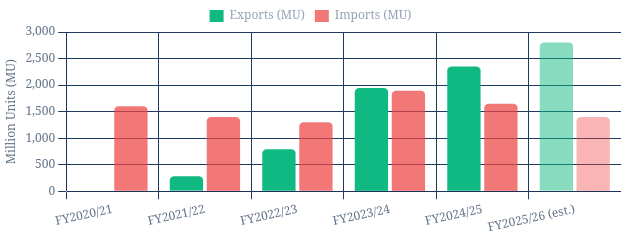
Source: NEA Annual Report 2024/25 · Rising Nepal Daily 2025 | FY2024/25 = confirmed · FY2025/26 = provisional GoN estimate · Faded bars = estimated
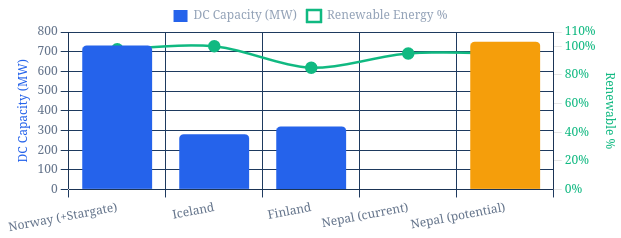
Source: Mordor Intelligence Nordic DC Market 2025 · Arizton Iceland DC 2025 · OpenAI Stargate Norway Jul 31, 2025 (230 MW added to Norway figure) · Hover bars for Stargate note
legend: Orange Nepal(Potential)| Red Nepal(Current) |Blue Nordic Benchmarks
Nepal's geography makes a competitive case that no Nordic country can fully replicate. High altitude, cold mountain air, and surplus hydropower combine to offer what data center operators pay premium prices to artificially recreate elsewhere. The World Bank estimates digital infrastructure investment in emerging economies generates four to six times its capital value in broader economic spillover effects.6 Nepal's National AI Policy 2082, approved August 2025, explicitly identifies data centers leveraging Himalayan cold temperatures as a strategic economic opportunity, the first time such language has appeared in a government document.
If Nepal were to attract 500 megawatts to 1 gigawatt of AI data center capacity,a realistic near-term target, the projected economic impact is substantial:
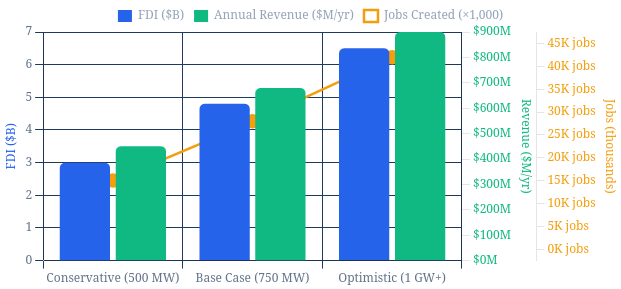
Source: World Bank Digital Economy benchmarks · IEA Data Center Investment Outlook 2025 · S&P Global Nov 2025 (hyperscalers committed $320B in 2025, up from $230B) · NEA tariff data
Revised upward from prior estimates: hyperscaler AI spend jumped 39% in 2025 alone · (Blue) FDI ($B) (green) Revenue ($M/yr) Jobs (×1,000) · World Bank multiplier: 4×–6× on invested capital.
What the Policy Has Done and What It Still Must Do
The August 2025 approval of AI Policy 2082 was genuine progress. The policy establishes an AI Regulation Council and National AI Centre, commits to training 5,000 AI professionals, integrates AI into health, education, agriculture, and public administration, and critically explicitly guides the opening of data centers leveraging cold temperatures in Himalayan regions. The November 2025 inauguration of the National AI Centre in Kathmandu was an implementation milestone, not merely a ribbon-cutting. Minister Jagadish Kharel noted at the inauguration: "This is just the beginning. AI policy is already in place. AI Council has also been formed."
"The draft is a governance document for AI use, not a development strategy for AI infrastructure and Nepal urgently needs both."
But approval is not execution. Global investment in data centers reached half a trillion dollars in 2024 alone1 and companies are competing for locations in real time. The policy still lacks the conditions that convert Nepal's natural advantages into signed investment agreements. The final architecture must close this gap with a sequenced, accountable roadmap:
- Anchor the legal framework. Pass a comprehensive national data protection law aligned with international standards. Without legally enforceable data protection legislation, no credible hyperscale operator will commit capital to Nepal regardless of how cheap or green its electricity is. This is a hard procurement requirement, not a soft preference.
- Create dedicated technology economic zones. Infrastructure zones near Upper Tamakoshi, Budhi Gandaki, and West Seti corridors with long-term power purchase agreements, streamlined FDI approval pathways, and guaranteed fiber connectivity to international cable networks do not yet exist. They need to be legislated, funded, and operational.
- Build carbon certification capacity. Create a national mechanism that allows data center operators to certifiably verify their renewable energy consumption for global ESG and sustainability reporting. This is the commercial credential that unlocks procurement from Google, Microsoft, and OpenAI. Without it, Nepal's clean energy is commercially invisible to the buyers who need it most.
- Fund cybersecurity workforce development. The policy commits to 5,000 AI professionals. It says nothing specific about cybersecurity specialists the distinct skill set that investment-grade digital infrastructure demands. A dedicated national programme, modeled on Estonia and Singapore, is required.
- Institutionalise MoFA in AI governance. Nepal's Foreign Secretary named green data centers a diplomatic priority in December 2025. That needs to become a structural integration formal, funded, and accountable not a personal priority of an individual officeholder.
The Rastriya Swatantra Party (RSP) has emerged as the dominant political force in Nepal’s 2082 parliamentary elections, marking a historic shift in the country’s political landscape. The party secured 125 out of 165 seats under the direct voting system, far ahead of traditional parties such as the Nepali Congress and CPN-UML. With strong support also under the proportional representation category, projections suggest that the RSP’s total representation in the 275-member House of Representatives could reach around 180 to 183 seats, placing it close to a two-thirds majority required for constitutional amendments.
Such a projected legislative majority is a political runway Nepal has not seen in a generation. Rare political mandates and rare economic opportunities do not often coincide yet Nepal now appears to be experiencing both at the same time. The coming months will determine whether this historic mandate is used for decisive policy execution and long-term reforms, or whether the moment is lost to prolonged political deliberation.
Structural Considerations for AI Infrastructure in Nepal.
As Nepal positions itself as a potential hub for green AI infrastructure, one issue that cannot be ignored is seismic risk. The country lies along the Himalayan seismic belt, making earthquakes a natural concern for any large-scale infrastructure project. For data centers which host critical digital systems and require uninterrupted operations, this means facilities must be designed with strong resilience standards from the start. Yet seismic exposure does not automatically rule Nepal out as a technology destination. Countries such as Japan and parts of the United States successfully operate major data centers in earthquake-prone regions by relying on advanced engineering, base-isolated structures, and multiple layers of system redundancy. With the right approach, Nepal can do the same. By enforcing strict building standards, carefully selecting geologically stable locations for technology parks, and incorporating seismic planning into national digital infrastructure policy, the country can manage these risks effectively. Taking these steps early would not only improve safety but also build the kind of investor confidence needed to position Nepal as a credible and reliable destination for sustainable AI and data center development.
The Cybersecurity Foundation
Nepal's green data center ambitions rest on a foundation that currently has cracks in it. The National AI Policy 2082 acknowledges this,the National Cybersecurity Policy 2023 is listed as a foundational document but acknowledgment is not remediation. Data center operators serving global technology clients evaluate the host country's legal framework, incident response capacity, and cybersecurity institutional maturity before capital decisions are made.
"There is no comprehensive data protection law. There is no national data classification framework. Nepal's cybersecurity human capital is underdeveloped relative to what a major digital infrastructure economy requires."
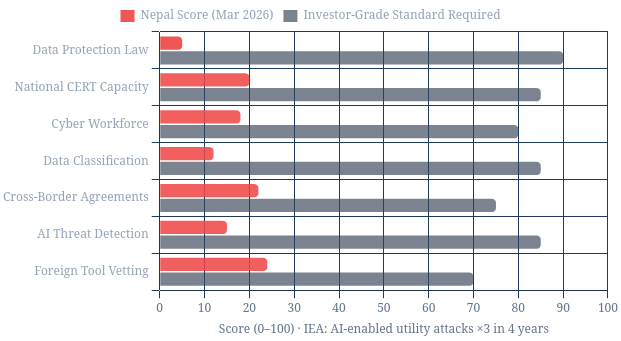
Source: CESIF Nepal AI & Diplomacy 2025 · ITU Global Cybersecurity Index 2024 · IEA 2025: AI-enabled attacks on utilities tripled in 4 years · Author assessment vs. investor-grade DC requirements
“ Nepal's Data Protection Law score: 5/100 (AI Policy 2082 passed Aug 2025 but no standalone data protection legislation yet as of Mar 2026). Cybersecurity investment must precede data center construction.”
Three interlocking vulnerabilities require immediate policy attention. First, the absence of unified data protection standards means sensitive data crossing Nepal's borders without regulatory oversight creates structural exposure to cybercriminals and state-sponsored actors. Second, Nepal's relatively undeveloped network infrastructure risks making it a testing ground for AI-driven cyber exploits before those techniques are deployed against higher-value targets, a pattern documented across developing-economy network infrastructure globally. Third, over-reliance on imported cybersecurity tools, where foreign AI systems may contain hidden vulnerabilities Nepal's institutions lack the technical capacity to detect, creates a strategic dependency that compounds over time.
Cybersecurity investment is not optional infrastructure to be added after the data centers are built. It is a precondition for the entire strategy. The policy must treat it accordingly with dedicated budget lines, not aspirational language.
Geopolitical Neutrality as a Strategic Asset
Perhaps Nepal's most underappreciated advantage is one that its rivers and mountains did not create , its geopolitical neutrality. The United States and China are locked in an AI supremacy contest that is reshaping investment decisions, supply chains, and regulatory environments worldwide. In January 2025, the release of DeepSeek's R1 model, built at a fraction of the cost of comparable American models, erased $589 billion of Nvidia's market capitalization in a single trading day, the largest single-day value destruction of any company in history.7 US officials immediately declared it "a wake-up call for the American AI industry." By March 2026, the competition has not cooled. It has accelerated. Countries around the world are being forced to choose sides in a technology contest that carries alignment consequences far beyond the technology sector.
"Nepal is genuinely neutral in the US-China technology contest and in a world where that neutrality is increasingly rare, it carries real commercial and diplomatic value."
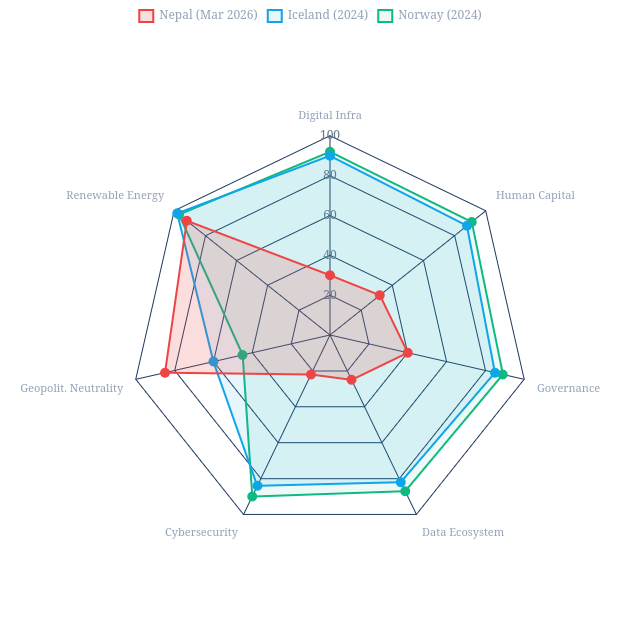
Source: Oxford Insights Government AI Readiness Index 2024 · Author 2026 adjustments: Nepal Governance +5 (AI Policy 2082 Aug 2025 + AI Centre Nov 2025) · Norway Neutrality −10 (Stargate deepens US tech alignment)
" Nepal's two standout dimensions that no Nordic country can match: Geopolitical Neutrality (85) and Renewable Energy (92). Norway's neutrality score reduced to 45 following Stargate alignment with US tech infrastructure. "
India is deepening its technology partnerships with Washington through TRUST, the successor to the iCET initiative. China is extending its Digital Silk Road across Asia with BRI integration expectations attached. Nepal, by contrast, sits between both systems without formal membership in either alliance structure. This is not passivity, it is position. Iceland and Finland, both NATO members, cannot fully replicate this neutrality for globally operating technology companies anxious about geopolitical alignment.
Nepal must pursue AI and digital infrastructure agreements simultaneously with India, China, the European Union, and the United States, applying to the technology domain the same strategic balancing that has defined its conventional foreign policy for decades. Nepal's Foreign Secretary said in December 2025 that Nepal must capitalise on its natural strengths in the AI era. That capitalisation requires parallel engagement across all four major technology blocs, not sequential diplomacy. Nepal's non-alignment doctrine is not an anachronism. In the AI era, it is a commercial asset and it needs to be priced accordingly.
The Decision Nepal Has to Make
Nepal currently ranks 150th out of 193 countries on the 2024 Government AI Readiness Index. That ranking reflects infrastructure deficits, institutional gaps, and a long pattern of policy ambition outrunning policy execution. A World Economic Forum analysis estimated that AI will help create 97 million new jobs globally by 2025 while simultaneously displacing 85 million others the net effect concentrated heavily in economies with the institutional readiness to capture new sectors while managing displacement in old ones. Nepal currently sits on the wrong side of that divide. The National AI Policy 2082 and the National AI Centre are the first steps toward changing that. They are not sufficient steps on their own.
"The hydropower is there. The cold air is there. The global demand for green computing infrastructure is there and growing. The political window rarer than any natural resources open right now."
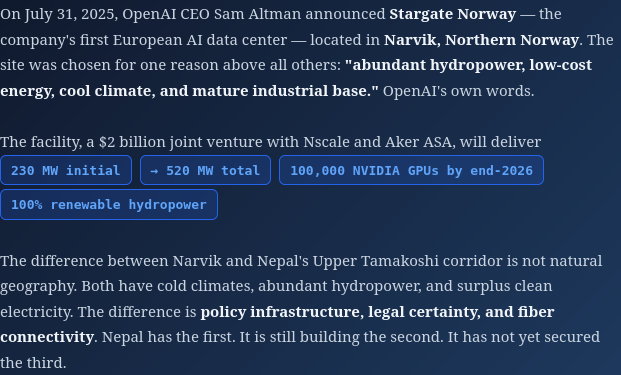
As of March 2026, companies worldwide are on track to invest nearly $7 trillion in data center infrastructure before 2030.2 That capital is not waiting for Nepal to finish deliberating. OpenAI chose Narvik hydropower, cold climate, politically stable, legally predictable for 230 megawatts of renewable-powered AI infrastructure. The pattern is unmistakable: cold, hydro-powered, legally secure locations are winning this competition. Nepal is cold. Nepal is hydro-powered. Nepal has now approved a national AI policy and inaugurated a national AI centre. What it has not yet done is build the legal and infrastructure conditions that translate those assets into signed investment agreements.
Iceland became a data center economy because it decided to become one, then built the conditions that made it happen. Nepal has more water, better geography, and a more strategically valuable location between the world's two largest economies. The first moves have been made. The window is still open. Plausible is not automatic.
The rivers are not waiting. Neither is the world.
References & Sources
- International Energy Agency. Energy and AI Special Report. IEA, Paris, 2025. iea.org/reports/energy-and-ai
- Programs.com. Measuring the Data Center Boom: Facts and Statistics 2026. March 2026. programs.com
- International Renewable Energy Agency. World Energy Transitions Outlook 2024. IRENA, Abu Dhabi, 2024.
- Mordor Intelligence. Nordic Data Center Market Report 2025–2030. 2025.
- Arizton Advisory & Intelligence. Iceland Data Center Market: Investment Analysis & Growth Opportunities 2025–2030. 2025.
- World Bank. Digital Economy for Africa and Emerging Markets: Infrastructure Investment Multipliers. World Bank Group, 2023.
- CESIF — Centre for Social Innovation and Foreign Policy. Artificial Intelligence and Diplomacy: A Case for Nepal's AI Diplomacy. Kushwaha, M.K., Neupane, R. & Khanal, A. Kathmandu, 2025. ISBN 978-9973-9630-5-3. cesifnepal.org
- Oxford Insights. Government AI Readiness Index 2024. Oxford Insights, UK, 2024.
- World Economic Forum. Future of Jobs Report 2023. WEF, Geneva, 2023.
- OpenAI / Nscale / Aker ASA. Introducing Stargate Norway. July 31, 2025. openai.com/index/introducing-stargate-norway
- The Kathmandu Post. Nepal rolls out ambitious AI policy. August 16, 2025. kathmandupost.com
- Rising Nepal Daily. National AI Centre inaugurated. November 10, 2025. risingnepaldaily.com
- Ministry of Foreign Affairs, Nepal. Remarks by the Foreign Secretary at Talk Program on AI and Its Implication for Nepal's Foreign Policy. December 7, 2025. mofa.gov.np





nice initiative
Saurav Ghimire
March 14, 2026 pm31 6:25 PM